
Aelova
A Murat-led product now within Devonair’s product ecosystem.
Visit Murat’s siteProducts
Products are decisions carried into behavior, systems, and the details people eventually depend on.
Personal products
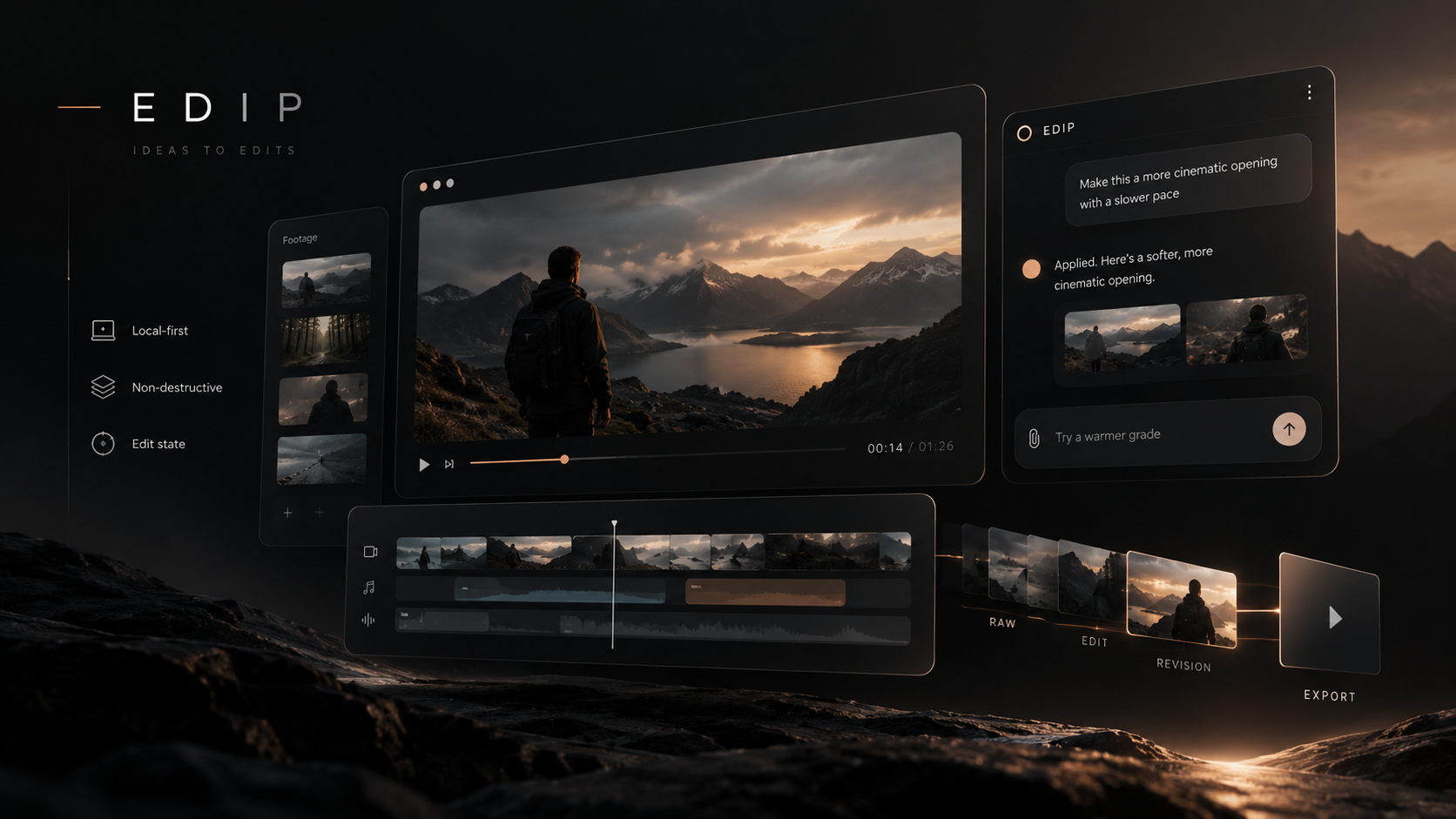
An AI-oriented video editor for creators.
Bring raw footage, describe the result you want, inspect the edit, and revise it conversationally. EDIP keeps source media and project ownership local while treating every edit as a controlled, non-destructive step. The goal is not to turn editing into a black box. You should be able to understand what changed, ask for another direction, and keep moving without rebuilding the whole timeline by hand.
Designed and built by Mehmet Arslanca.
Devonair products
I also build as part of Devonair, the software, products, and systems side of Ebiren. Shared products stay explicitly shared; collaboration does not erase ownership.
Visit Devonair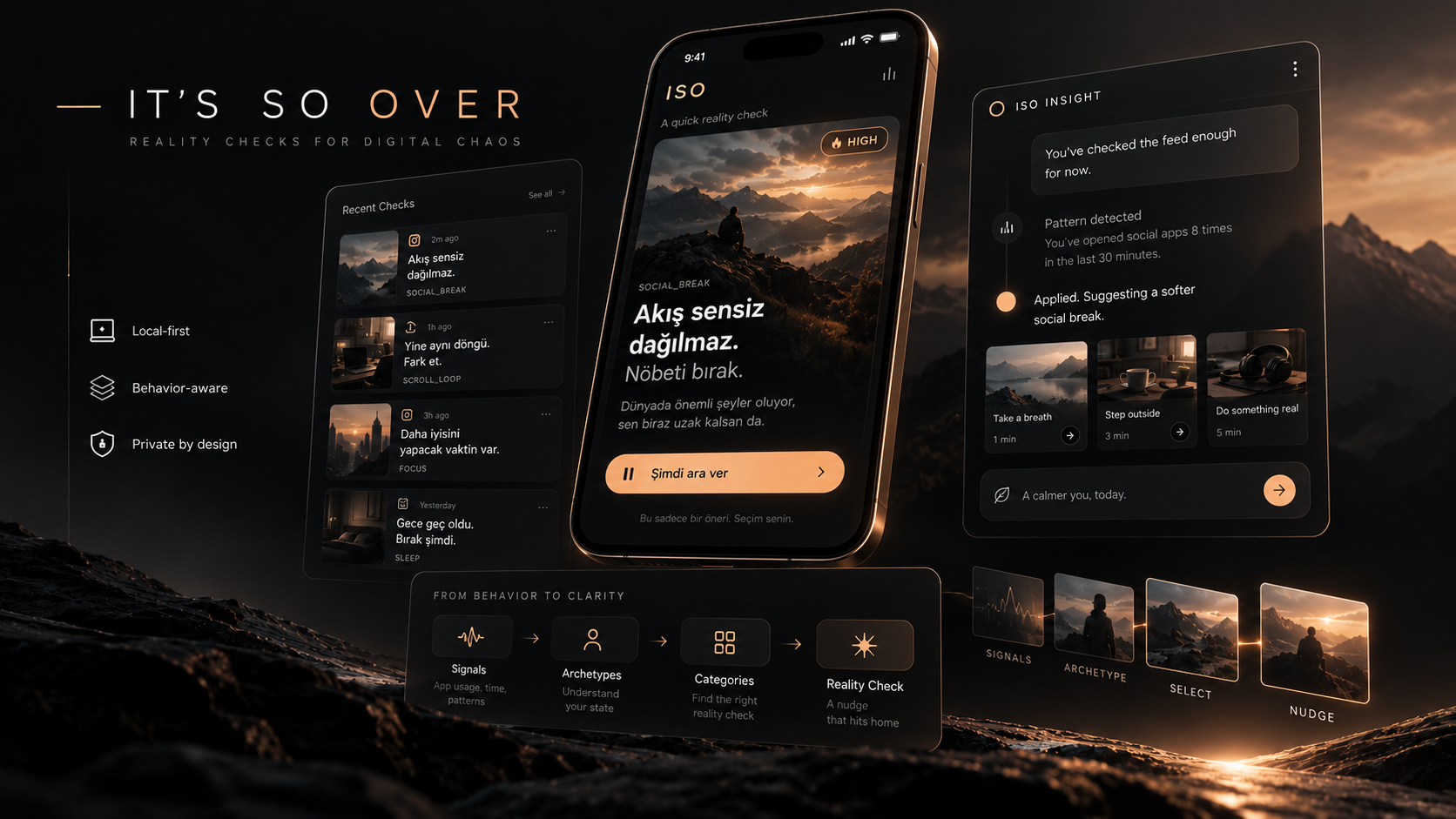
Local-only behavioral reality checks.
IT’S SO OVER is a local-only Android product built around behavioral reality checks. A constrained set of permissioned device signals is turned into on-device behavioral context, then used to decide whether a timely nudge is worth making and which curated message actually fits the moment.
Its tone is deliberately dry and sharp. It makes the behavior visible without pretending to know more about the person than the device can actually support.
Built by Mehmet Arslanca and Murat Bahadır Kayıhan.
View on DevonairBroader ecosystem
A Murat-led product now within Devonair’s product ecosystem.
Visit Murat’s siteA Murat-led product now within Devonair’s product ecosystem.
Visit Murat’s siteAn honest postmortem
PersonalArchived
This one didn’t make it.
This one didn’t make it. OrchestrAI explored serious LLM and provider orchestration through a production-minded backend. The original question was real: how could a product coordinate providers and models without coupling its behavior to any one of them? Authentication, persistence, streaming, and orchestration were treated as parts of one coherent system rather than a disposable demo. The ecosystem then moved quickly enough that parts of the original value were implemented or commoditized elsewhere. Continuing would have meant spending more time defending an old premise than solving a useful problem, so I archived it. Stopping was the better product decision.
Its backend was treated seriously, but the reason to keep building it weakened. Archiving it was the point where the product decision became clearer than the implementation momentum.
Technical footprint
Experiments / earlier work
PersonalLearning-era
An earlier Android learning project kept here because it belongs to the path, not because it represents my current product work.
Android / Kotlin
PersonalExperiment
A small local automation experiment for monitoring a remote backup device’s location and sending Telegram notifications from configurable geographic zones, replacing a manual check with a private local tool.
Python / SQLite / Telegram bot / systemd / Local scheduling / Geographic zone logic